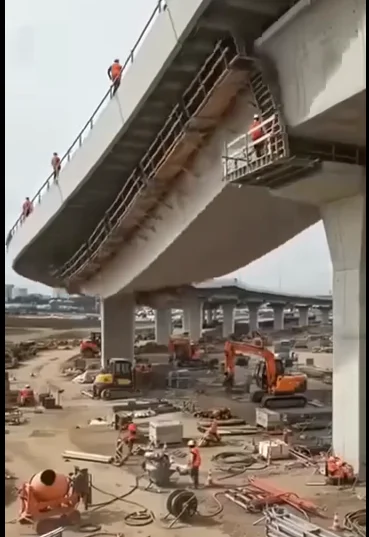
The morning began like any other at the construction site—workers in hard hats moved methodically across steel beams, engineers reviewed plans, and cranes towered overhead against a hazy skyline. The ambitious skybridge project, once a symbol of progress and connectivity, was nearing a critical phase.
But within seconds, everything changed.
A Sudden, Terrifying Collapse
Eyewitnesses described a chilling sequence: massive steel beams—each stretching over 150 feet—began to give way one after another. What started as a faint metallic creak quickly escalated into a deafening roar as sections of the skybridge collapsed in a domino-like effect.
Workers scrambled to escape. Some leaped from unstable platforms, while others were trapped amid falling debris. Dust clouds engulfed the site, reducing visibility to near zero. The scene turned from controlled construction to utter chaos in mere moments.
Panic and Rescue Efforts
Emergency sirens pierced the air as rescue teams rushed in. Firefighters, paramedics, and police units worked frantically, pulling survivors from twisted metal and shattered concrete. Heavy machinery was deployed to lift debris, while search teams combed through the wreckage for anyone still trapped.
Incidents like these often demand massive rescue operations. In a similar bridge construction collapse in China, over 800 responders and specialized equipment were mobilized to search for victims after a structural failure.
Though exact casualty numbers from this skybridge collapse remain unclear, early reports suggest multiple injuries, with fears of fatalities mounting.
What Went Wrong?
While investigations are still underway, early speculation points to structural failure during a critical phase of construction. Experts note that temporary supports and load distribution are especially vulnerable during assembly.
History offers sobering parallels:
- The Florida International University pedestrian bridge collapse was caused by design miscalculations that led to structural cracking and eventual failure.
- The Francis Scott Key Bridge collapse highlighted how a single point of failure can bring down an entire structure within seconds.
- In other cases, snapped cables or unstable terrain have triggered catastrophic collapses during construction.
These tragedies underscore a harsh reality: even minor oversights in engineering or safety protocols can have devastating consequences.
Human Stories Behind the Steel
Beyond the headlines are the workers—fathers, sons, and colleagues—who risk their lives daily to build the infrastructure we rely on. Survivors spoke of fear and disbelief, recounting how routine tasks suddenly turned life-threatening.
One worker reportedly said the structure “just started shaking,” before everything gave way. Moments like these leave lasting scars—not only physically, but emotionally.
A Wake-Up Call for the Industry
This collapse raises urgent questions about construction safety standards, inspection protocols, and accountability. Are deadlines being prioritized over safety? Were warning signs ignored?
Authorities have vowed a full investigation, and construction firms involved may face scrutiny—or even legal consequences—depending on the findings.
Conclusion
The fallen skybridge now stands as a stark reminder of both human ambition and vulnerability. What was meant to connect communities has instead left devastation in its wake.
As rescue efforts continue and families await news, one truth remains clear: progress should never come at the cost of safety.